
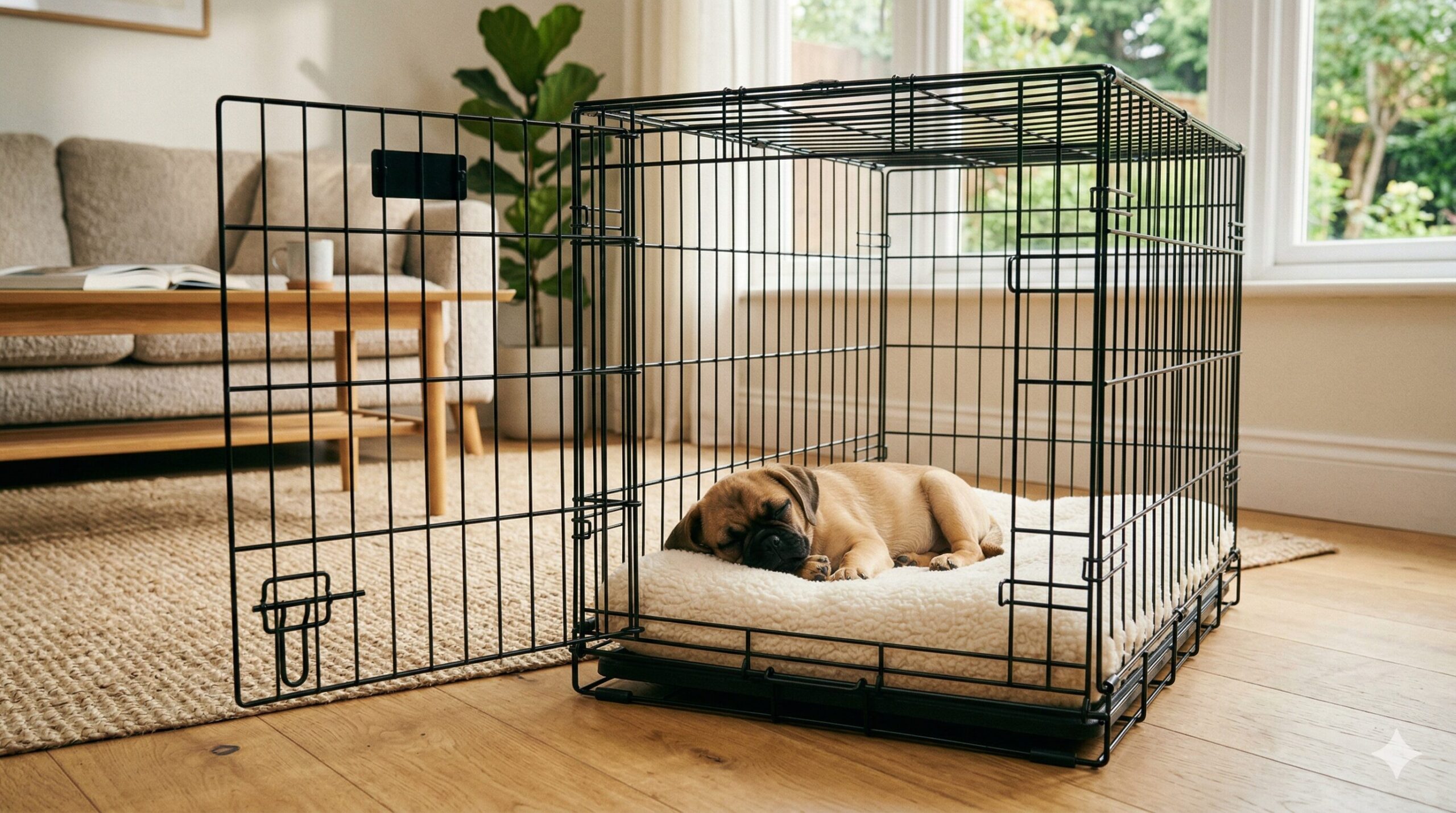
Knowing how to crate train a puppy is one of the most valuable skills a new dog owner can develop — not because puppies need to be confined, but because a dog that genuinely likes their crate has a safe, comfortable retreat for life. Done right, learning how to crate train a puppy is compassionate, effective, and creates a dog that willingly goes to their crate when they need rest. Done wrong — rushing, forcing, or using the crate as punishment — it creates anxiety and a dog that panics at confinement.
This guide uses a gradual, schedule-based approach to how to crate train a puppy. No “cry it out.” No forcing. Just systematic, patient training that builds real comfort rather than resigned tolerance.
Why Learning How to Crate Train a Puppy Matters
A crate-trained dog is safer and easier to manage. The crate serves critical functions:
- House training — Dogs instinctively avoid soiling where they sleep. A properly sized crate teaches bladder control and creates structured bathroom break opportunities.
- Safety — Unsupervised puppies chew electrical cords, eat toxic plants, and swallow socks. A crate keeps them safe when you can’t actively watch.
- Veterinary stays — Dogs that know how to crate train a puppy experience have significantly less stress during overnight hospital stays.
- Travel — Whether flying or driving, a crate-comfortable dog is a calmer traveler.
- Preventing destructive behavior — Setting your puppy up for success in the first months prevents habits that are hard to break later.
Choosing the Right Crate Before You Start
Before you can begin learning how to crate train a puppy, you need the right equipment. Crate sizing matters enormously — too small is cruel, too large undermines house training.
The right fit: Your puppy should stand up without hunching, turn around completely, and lie down stretched out. No more space than that during house training. Extra space lets puppies use one end as a bathroom.
For large-breed puppies, buy a crate sized for your dog’s adult dimensions and use a divider panel to block off the excess space. The MidWest iCrate [Amazon] ($65–$110) includes a divider and is our top recommendation for most families. See our best dog crates for large dogs for size-specific guidance.
Wire crates let your puppy see their surroundings and adjust faster — most puppies learning how to crate train a puppy settle better in wire crates because they feel less isolated. A crate cover [Amazon] ($25–$35) that drapes over the sides creates a den-like environment many puppies find calming.
A Snuggle Puppy Behavioral Aid Toy [Amazon] ($40–$50) — a stuffed toy with a simulated heartbeat and heat pack — dramatically reduces nighttime crying for newly separated puppies. Many owners consider it essential for the first few weeks of how to crate train a puppy.
Age-Appropriate Time Limits
A core principle of how to crate train a puppy is understanding bladder capacity. Puppies can hold their bladder roughly one hour per month of age — and that’s the maximum, not the goal.
| Puppy Age | Maximum Crate Time (awake) | Overnight (with interruption) |
|---|---|---|
| 8–10 weeks | 30–60 minutes | 3–4 hours maximum |
| 10–12 weeks | 1–2 hours | 4–5 hours |
| 3–4 months | 2–3 hours | 5–6 hours |
| 4–5 months | 3–4 hours | 6–7 hours |
| 6+ months | Up to 4 hours | Up to 8 hours |
No puppy under 6 months should be crated all day. If you work full-time with a young puppy, you need a dog walker, neighbor, or daycare providing midday breaks. This is a non-negotiable part of how to crate train a puppy responsibly.
Day-by-Day Introduction: How to Crate Train a Puppy
Days 1–3: Open Door Exploration
The crate door stays open all day. Do not close it yet.
Place the crate in a central, lived-in area of your home — not a basement or spare bedroom. Puppies learning how to crate train a puppy adjust faster when the crate is in the social center of the house.
Toss high-value treats just inside the crate door. When your puppy goes in to retrieve them, say “yes!” and reward. Don’t push them in or lure too far — let them discover it on their own terms.
Feed meals near the crate: day one outside the door, day two at the threshold, day three just inside (door still open). By the end of day three, your puppy should be walking freely in and out.
What you’re building: Positive associations that make the rest of how to crate train a puppy go smoothly.
Days 4–6: Short Closed-Door Sessions
Now introduce the door — but only for brief moments.
Lure your puppy inside with a treat. Once in, give the treat and immediately close the door for 5–10 seconds. Give another treat through the door. Open. Lots of praise.
Practice 5–10 times per day, gradually extending the closed-door duration: 10 seconds, 30 seconds, 1 minute, 2 minutes. Never push past your puppy’s comfort.
Use a stuffed KONG Classic [Amazon] ($12–$20) as a crate reward — fill with peanut butter and freeze it. Give it only when your puppy enters the crate. This is a reliable tool in how to crate train a puppy because the KONG itself becomes a cue that crate time is starting.
Critical rule: Do not open the door while your puppy is actively crying. Wait for even a brief pause before opening. Opening during crying teaches them that crying is the exit key.
Week 2: Building Duration
By week two, your puppy should be tolerating 5–10 minutes in the closed crate without distress.
Work toward 15, then 30, then 60 minutes. Stay nearby during these sessions — sit in the same room. Your puppy can hear and smell you; they’re just not with you physically. This builds independence without abandonment, which is the heart of how to crate train a puppy.
Practice leaving the room briefly while your puppy is crated. Return before distress escalates. Return calmly — no dramatic greetings.
By the end of week two, most puppies can handle 1–2 hours in the crate with minimal distress.
Week 3+: Routine Crating
By week three, your puppy can be crated during naps, meals, when you leave the house, and at night. Build a consistent schedule — puppies learning how to crate train a puppy thrive on predictable routine.
Continue enforcing the time limits from the table above. Don’t expect a 10-week-old to hold it for 4 hours regardless of need.
Handling Nighttime Crying
Nighttime is where most how to crate train a puppy efforts stumble. Here’s an honest breakdown.
Some crying is normal in the first few nights. Your puppy has been taken from their mother and siblings. The crying is grief and adjustment, not manipulation. It diminishes within 3–7 days for most puppies.
Keep the crate close at night. Place it next to your bed so your puppy can hear, smell, and see you. This dramatically reduces nighttime distress. Move it to its permanent location gradually over a few weeks.
Set an alarm. Young puppies (8–10 weeks) need a nighttime bathroom trip regardless of crying. Take them out quietly, with minimal stimulation — bathroom visit only, no play. Back in the crate with lights low.
What not to do: Don’t take your puppy into bed unless you intend to share your bed permanently. Don’t let them out while actively crying. Don’t move the crate to a separate room — knowing you’re nearby is part of what’s reassuring.
Separation Anxiety vs. Normal Adjustment
Normal how to crate train a puppy adjustment: some whining and crying the first few days, which diminishes as the puppy settles in. By 2–4 weeks, a puppy with normal adjustment settles quietly within a few minutes of being crated.
Separation anxiety: escalating distress that doesn’t improve with time, frantic escape attempts resulting in injury, or distress that begins the moment you leave the room — not just when crated. True separation anxiety often involves vomiting or self-injury even after weeks of training.
If you’re seeing signs of true separation anxiety rather than normal adjustment, consult your veterinarian. Separation anxiety is a real anxiety disorder — not a training failure — and it often benefits from behavioral modification and sometimes medication.
The information on Real Dog Answers is for educational purposes only and does not replace professional veterinary advice. Always consult your veterinarian before making changes to your dog’s diet, exercise, or health routine.
For comfortable crate bedding options, see our best dog beds for large breeds guide. And if you’re just getting started with a new puppy, our best dogs for first-time owners covers breed-specific expectations for the crate training process.
Frequently Asked Questions: How to Crate Train a Puppy
How long does crate training take?
Most puppies show meaningful crate acceptance within 1–2 weeks of the gradual approach described in this how to crate train a puppy guide. Full comfort — willingly entering and settling without distress — typically develops within 3–6 weeks. Individual temperament, consistency, and whether any negative experiences have occurred all affect the timeline.
Is crate training cruel?
Not when done correctly. Dogs are denning animals — many choose small, enclosed spaces even when they have full access to a home. A crate introduced positively, sized appropriately, and used within age-appropriate time limits is a comfortable, secure space. What’s unkind is forcing a puppy too quickly, confining them beyond their capacity, or using the crate as punishment. The how to crate train a puppy process described here avoids all of those.
My puppy cries all night in the crate. What should I do?
Move the crate next to your bed. Check basic needs — comfort, a recent bathroom trip, age-appropriate time limits. Try a Snuggle Puppy for the first week. Don’t take them out while actively crying — wait for a pause. If distress is extreme and doesn’t improve after 1–2 weeks, consult your vet to rule out separation anxiety.
How do I know if my puppy needs a bathroom trip or is just crying?
After a pre-crate bathroom trip, monitor patterns: if your puppy wakes after sleeping for a while and cries with urgency, take them out. If they cry immediately upon entering the crate, that’s adjustment crying. Most owners can distinguish the sounds within a few days of consistent how to crate train a puppy practice.
Should I put a blanket from the breeder in the crate?
Yes — genuinely helpful for newly arrived puppies. A blanket that smells like their mother and littermates provides comfort during adjustment. Ask your breeder if you can send a small cloth to the pickup to be scented before your puppy comes home.
When can I stop using the crate?
There’s no set age. It depends on your individual dog demonstrating reliable house training and no destructive behavior when unsupervised — typically between 12–18 months for most dogs. The transition is gradual: start with short unsupervised periods in a puppy-proofed room before expanding freedom. Some dogs prefer sleeping in their crate their whole lives, and that’s perfectly healthy.