
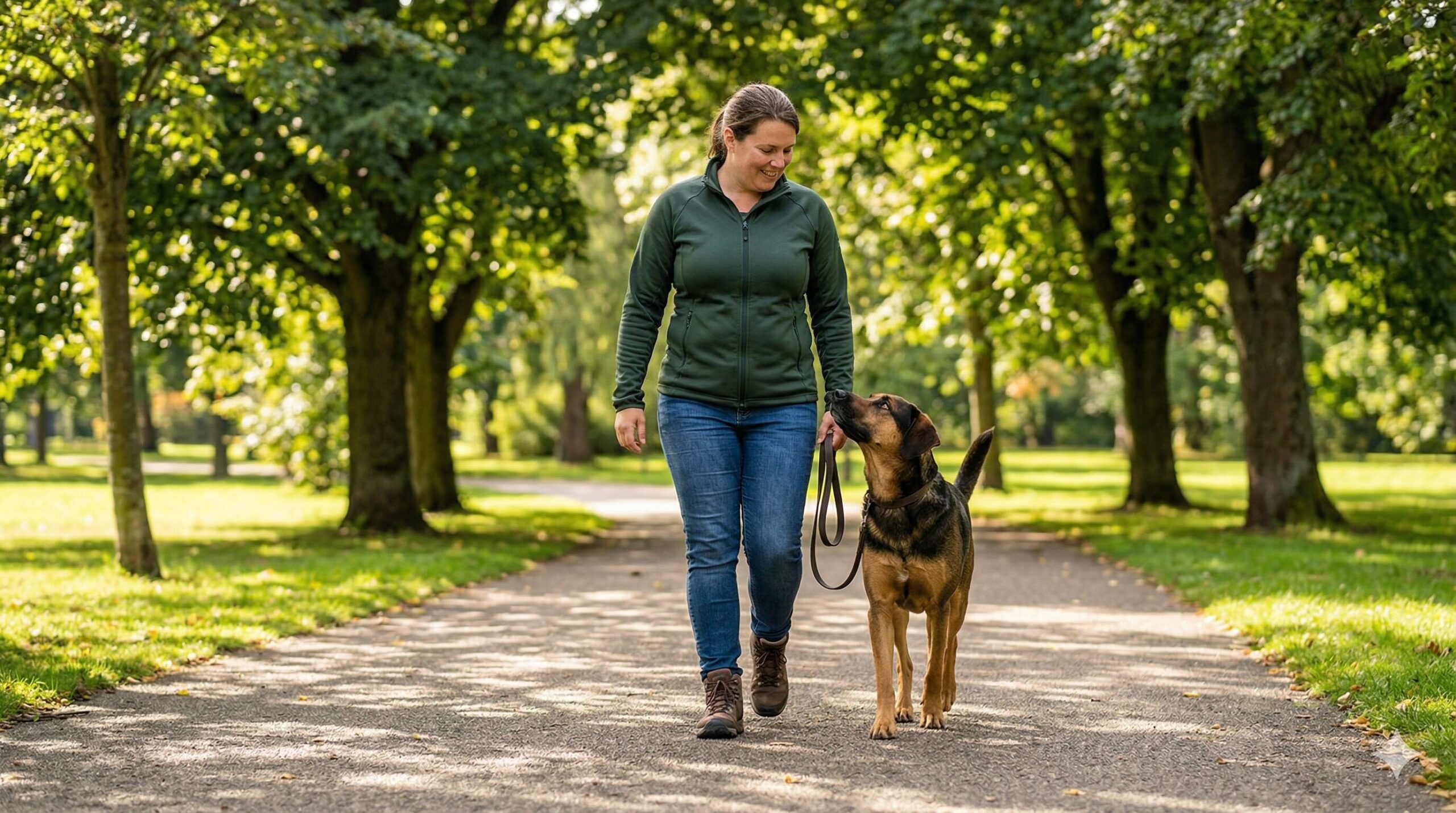
Knowing how to stop dog from pulling on leash is one of the most requested training skills — and one of the most commonly taught incorrectly. Most owners try to correct pulling with leash jerks, frustrated commands, or sheer physical resistance. None of these work long-term. Understanding how to stop dog from pulling on leash requires understanding why dogs pull in the first place, then systematically teaching an alternative behavior.
The good news: with the right method and equipment, even chronic pullers can learn to walk politely. Here’s exactly how to do it.
Why Dogs Pull (And Why It Matters for How to Stop Dog From Pulling on Leash)
Dogs pull because pulling works. When they lunge forward, they reach the interesting smell, the other dog, the fire hydrant. Every time pulling results in forward progress, the behavior is reinforced. The dog didn’t learn bad manners — they learned basic physics.
Dogs also operate at a fundamentally different pace than humans. Their olfactory brains process scent information at a depth we can barely imagine — a walk is a full sensory experience of the neighborhood’s entire history. Their natural pace is often faster than ours, and instincts in working, herding, and northern breeds push hard toward forging ahead.
None of this is defiance. Learning how to stop dog from pulling on leash means working with these instincts rather than against them — teaching a clear alternative and making walking at your side more rewarding than pulling forward.
Equipment That Supports How to Stop Dog From Pulling on Leash
The right gear makes the training process significantly more efficient. You don’t need special equipment to teach loose-leash walking, but the right tools help.
Front-clip no-pull harness: A front-clip harness physically redirects a pulling dog back toward you when they forge forward. It doesn’t punish — it removes the mechanical advantage of pulling. The Ruffwear Front Range Harness [Amazon] ($45–$65) is durable and comfortable for all-day use. The PetSafe Easy Walk [Amazon] ($20–$30) is a solid, affordable entry-level option.
High-value treats: The treats you use when learning how to stop dog from pulling on leash must be worth competing with squirrels and street smells. Small, soft, high-odor treats win over dry biscuits. The Zuke’s Mini Naturals [Amazon] ($10–$15) and Vital Essentials Freeze-Dried Treats [Amazon] ($12–$18) are proven favorites.
Treat pouch: A PetSafe Treat Pouch [Amazon] ($15–$20) clips to your waistband and keeps rewards instantly accessible.
Standard 6-foot leash: The right tool for training. Avoid retractable leashes — they extend when dogs pull forward, literally rewarding the behavior you’re trying to eliminate.
Method 1: Stop and Wait
This is the right starting point for any owner learning how to stop dog from pulling on leash — especially for puppies and dogs new to leash work.
How it works: The moment your dog hits the end of the leash and creates tension, you stop completely. No yanking, no talking, no moving — you become a statue. Wait until your dog releases the tension: they might look back at you, take a step back, or simply stop pulling. The instant the leash goes slack, say “yes!” and reward with a treat, then continue walking.
The message to your dog: Tension stops movement. Slack creates forward progress.
This method requires patience — early sessions may feel like you’re stopping every 5 seconds. That’s normal and correct. Consistency is essential: one session of following a pulling dog sets back your progress significantly.
Practice tip: Practice in your driveway or backyard first, without competing distractions. Let your dog understand the concept before adding the difficulty of a real walk.
Method 2: Change Direction
This is particularly effective for dogs that are highly distraction-driven and don’t respond well to stopping alone. It’s a key part of how to stop dog from pulling on leash for energetic breeds.
How it works: The moment your dog pulls ahead, you turn and walk in the opposite direction — without warning or fanfare. Your dog suddenly finds themselves going the wrong way and has to hustle to catch up. When they reach your side, reward with a treat and praise. When they pull again, turn again.
Early sessions look chaotic — you’ll be zigzagging all over the place. That’s correct. The randomness means your dog must watch you rather than assume they know where you’re going.
Key technique: Turn away from the dog, not into them. Turning into the dog risks tripping or tangling.
Combine with Method 1: Many trainers use Stop and Wait followed by a direction change if the dog doesn’t self-correct within a few seconds.
Method 3: Reward-Based Position Training
This is the most effective long-term approach to how to stop dog from pulling on leash — but it requires the most upfront investment.
How it works: You’re teaching your dog that the position at your left hip is the most rewarding place to be. Start in your house or yard with zero distractions. Hold a treat at your left hip. Take one step. If your dog stays in position, mark (“yes!”) and reward. Take two steps. Reward. Build gradually.
Add a cue word — “with me,” “heel,” or “let’s go” — once the position is understood. Say it once before starting, not repeatedly.
Bring this outside only after it’s solid in low-distraction environments. The progression matters: your dog needs to understand the behavior before executing it under real-world stimulation.
Reward frequently at first. During early outdoor sessions, treat every 3–5 seconds of correct position. As reliability builds, gradually extend the interval.
Age-Specific Advice for How to Stop Dog From Pulling on Leash
Puppies (8–18 weeks)
Start leash work early but keep expectations realistic. Young puppies have 2–3 minutes of focus per session. Multiple short sessions per day beat one long session.
Build positive associations with the leash and harness first — put them on, give treats, play, remove. Don’t force training walks before your puppy is comfortable with the equipment.
When walking begins, keep sessions to 5–10 minutes in low-distraction areas. Stop and Wait works well because you’re teaching the concept before distractions complicate it.
Adolescent Dogs (6–18 months)
This is the hardest phase of how to stop dog from pulling on leash. Adolescent dogs have peak energy, drive, and diminished impulse control. Training progress often seems to regress because the same hormones flooding their system make focus harder.
Don’t give up. Be consistent. Use your highest-value treats. A front-clip harness is especially valuable during adolescence because it provides mechanical assistance while self-control develops.
Exercise before training sessions — a dog that’s blown off some energy is dramatically easier to work with.
Adult Dogs With Established Pulling Habits
Adult dogs with years of pulling history take longer to retrain. The behavior is deeply reinforced and you’re asking them to abandon a fundamental assumption about how leash walking works.
The Stop and Wait method is particularly effective here, combined with a front-clip harness. Expect 2–4 weeks of consistent daily practice before seeing reliable improvement. Occasional practice spread over months will not produce the same result.
Common Mistakes That Undermine How to Stop Dog From Pulling on Leash
Repeating commands. “Heel, heel, heel, HEEL” as your dog pulls teaches them to ignore the word. Say the cue once, then use your body and the methods above.
Letting pulling work sometimes. If your dog pulls to the dog park and you follow because you’re already late, you’ve reinforced the behavior that day. Pulling must never result in forward progress.
Using a retractable leash during training. Retractables extend when dogs pull forward — the exact opposite of what you need when teaching how to stop dog from pulling on leash.
Inconsistency between family members. Every person who walks the dog must use the same approach. Inconsistency teaches the dog to pull specifically when the “soft” handler is around.
For more on walking gear that supports training, see our dog harness vs collar guide. For breed-specific leash expectations, our best dogs for first-time owners covers what different breeds are like on the walk.
Frequently Asked Questions: How to Stop Dog From Pulling on Leash
How long does it take to stop a dog from pulling?
For puppies learning from scratch: 2–6 weeks of consistent daily practice. For adult dogs with established habits: 4–8 weeks of daily consistency. Owners who practice 2–3 times per week take significantly longer. Daily practice is the most important factor in how to stop dog from pulling on leash effectively.
What is the fastest way to stop leash pulling?
The fastest improvement comes from combining a front-clip harness (immediate mechanical help) with the Stop and Wait method (immediately teaches that pulling stops progress). Most dogs show noticeable improvement within a week of consistent use.
Should I use a choke chain or prong collar for pulling?
We don’t recommend aversive collar tools for everyday pulling. They can cause neck injury, and research on aversive training methods consistently shows positive reinforcement produces more reliable, longer-lasting results. Front-clip harnesses accomplish the same goal without the risks — and are the safer approach to how to stop dog from pulling on leash.
My dog only pulls toward other dogs. Is this different?
Yes — this is leash reactivity, not simply pulling, and it requires targeted behavior modification beyond basic how to stop dog from pulling on leash techniques. The same loose-leash principles apply, but you’ll need to add distance management and desensitization/counter-conditioning specifically for other dogs. For severe reactivity, a certified professional trainer (look for CPDT-KA certified trainers) is worth the investment.
Do no-pull harnesses work without training?
A front-clip harness reduces pulling immediately through mechanical redirection, but it doesn’t teach your dog anything on its own. Without training, the pulling returns the moment you use different equipment. Use the harness as a management tool while building trained loose-leash behavior — the goal of how to stop dog from pulling on leash is to eventually not need mechanical assistance.
Can I train my adult dog to stop pulling?
Absolutely. Adult dogs take longer than puppies to retrain because established habits are deeply reinforced, but with daily consistency they reliably improve. Many owners find their adult dogs responding well within 3–6 weeks of applying the Stop and Wait method combined with a front-clip harness.